
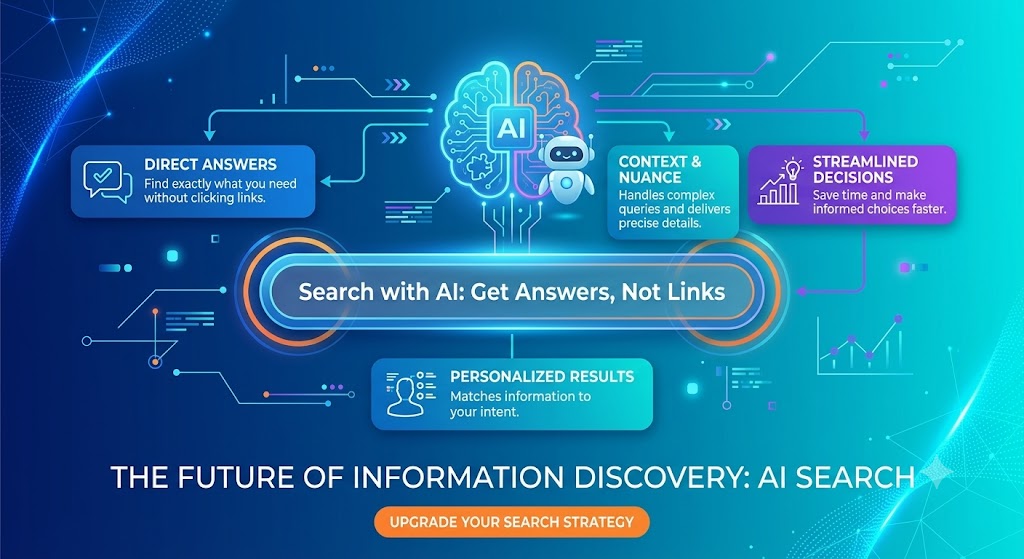
For the past two decades, the playbook for getting discovered online was simple: optimize your website for Google’s desktop and mobile search algorithms, rank on page one, and collect the clicks.
But search behavior has fundamentally changed. Today, consumers aren’t just typing fragments into a search bar; they are holding full conversations with AI. They are asking ChatGPT for business recommendations, querying Google AI Overviews for quick summaries, using Gemini on their mobile devices, and relying on Apple Intelligence via voice commands.
If your business is still relying entirely on traditional SEO, you are missing out on a massive wave of traffic. To stay visible, companies must integrate two critical modern marketing frameworks into their digital strategies: AEO (Answer Engine Optimization) and GEO (Generative Engine Optimization).
What is AEO (Answer Engine Optimization)?
Answer Engine Optimization is the practice of structuring your digital content specifically to be sourced by “answer engines.” Platforms like Amazon Alexa, Apple Siri, Google Assistant, and the conversational snippets at the top of Google results prioritize direct, unambiguous answers to specific user questions.
Traditional SEO targets broad keywords (e.g., “Orlando digital marketing agency”). AEO targets the exact conversational query a user says or types (e.g., “Who is the best local marketing agency near me that handles lead generation?”).
What is GEO (Generative Engine Optimization)?
Generative Engine Optimization is a newer concept built explicitly for large language models (LLMs) like ChatGPT, Claude, and Gemini. When a user asks an AI model to evaluate options or synthesize information—such as, “Give me a comparison of the top commercial roofing materials for Florida heat”—the AI doesn’t just return a list of links. It scrapes thousands of sources, filters for high-authority data, and generates a personalized, multi-paragraph response.
GEO is the strategic process of ensuring your brand’s facts, statistics, and domain authority are integrated so deeply into the digital ecosystem that AI engines actively synthesize and recommend your company over your competitors.
How to Integrate AEO and GEO Into Your Marketing Strategy
Transitioning your marketing plan to accommodate AI-driven search doesn’t mean throwing away your traditional SEO efforts; it means enhancing them. Here are the core pillars your business should adopt today:
1. Pivot to Conversational, Long-Tail Content
AI users communicate naturally. To map your content to their queries, your website needs to shift away from rigid keyword stuffing and move toward a natural Q&A style framework.
-
The Strategy: Build comprehensive FAQ modules, detailed “How-To” guides, and blog content that addresses exact consumer pain points. Frame headers as literal questions and provide authoritative, concise answers directly beneath them.
2. Deploy Advanced Schema and Structural Markup
AI web scrapers need to verify facts instantly. If your website code is disorganized, an AI engine will bypass it for a competitor whose data is clean.
- The Strategy: Use JSON-LD Schema markup. This background code explicitly labels your business address, services, pricing, and operating hours for search bots. It removes the guesswork for AI, making your content much easier to scrape and cite.
3. Build Local Context and Heavy Proximity Authority
For service-based and brick-and-mortar businesses, proximity search is everything. When an AI model generates local recommendations, it cross-references maps, local directories, and review sentiment.
-
The Strategy: Maintain a flawless, deeply optimized Google Business Profile and ensure your business citations (Name, Address, Phone number) are perfectly identical across the web. The more consistent your local footprint, the more confident an AI engine will feel recommending you to nearby users.
4. Prioritize Brand Sentiment and Digital PR
AI engines don’t just read your website; they read what everyone else says about you. They analyze customer reviews, forum discussions (like Reddit), digital news articles, and social media sentiment to determine if you are a reputable brand.
-
The Strategy: Actively encourage detailed, keyword-rich customer reviews. Invest in digital PR to get your brand mentioned on third-party industry blogs and news sites. High-quality external citations are the ultimate validation for an AI search algorithm.
The Future of Digital Discovery
The internet is transitioning from a library of links into a network of synthesized answers. The businesses that adapt their marketing plans to feed these AI models with clear, structured, and authoritative data will capture the market share. Those who ignore AEO and GEO risk becoming invisible to the next generation of consumers.
Want to ensure your brand is the one AI models are recommending? Contact TCS Media Group today to explore how we can audit your digital footprint and align your business with the future of search optimization.